


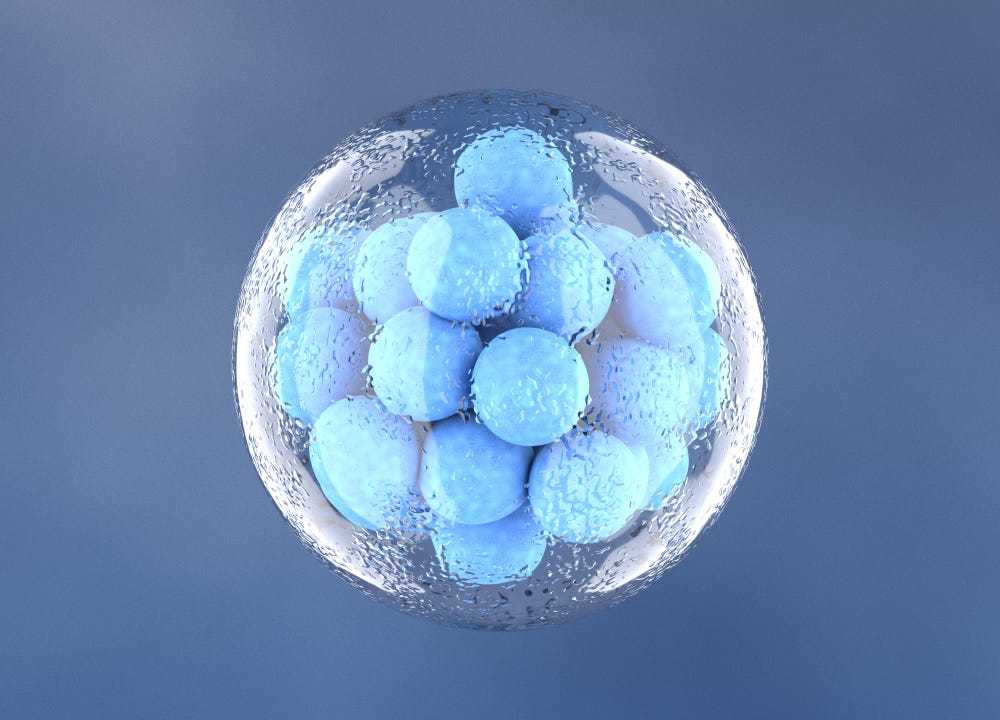
One of the strongest biblical defenses that embryos are truly human from conception, body and soul, is the incarnation of Jesus Christ in Mary’s womb. The account in Chapter 1 of Luke’s Gospel shows that even in the earliest stages in the womb, Jesus was already recognized by John the Baptist’s mother as “my Lord.”
The Beginning of Jesus’s True Humanity
The final book in the Old Testament was written by the prophet Malachi. After his ministry, there were over four hundred years of prophetic silence until John the Baptist and Jesus began to preach. But Luke tells us that the angel Gabriel prophesied before they were even conceived.
God sent the angel Gabriel to Mary while she was in Nazareth. She had been betrothed to Joseph, meaning she was married to him but not living with him and had not consummated the marriage. Mary, like many others in Scripture who saw and spoke with angels, was afraid, but Gabriel told her not to fear for she was highly favored by God. She would conceive a Son and would call Him Jesus. He would be the Son of God and would reign on David’s eternal throne and over the descendants of Jacob forever (Luke 1:26-33).
When Mary asked how this could happen since she was a virgin, Gabriel replied, “The Holy Spirit will come upon you, and the power of the Most High will overshadow you; therefore the child to be born will be called holy—the Son of God” (Luke 1:35). He also told her that Elizabeth, her cousin, who was elderly and barren, was already six months pregnant, for nothing is impossible with God. Mary responded in faith, believing all that Gabriel told her, and he left her (Luke 1:36-38).
The King in Mary’s Womb
Soon after Mary heard that her cousin Elizabeth was six months pregnant, she hurried from Nazareth to the hills in Judah, a fifty-to-seventy-mile journey to where Elizabeth lived (Luke 1:39).[1] The travel would have taken around 3 to 5 days, depending on her mode of transportation.[2]
When Mary arrived and greeted Elizabeth, John the Baptist leaped in her womb, and she was filled with the Holy Spirit. She exclaimed, “Blessed are you among women, and blessed is the fruit of your womb (Luke 1:42)!” Although it had only been a few days, Mary was already pregnant.
Elizabeth did not call Mary “blessed” because she was carrying a clump of cells, for every human body is full of various cell-clumps. Even cancers are clumps of cells. Mary was carrying a very young child that was the “fruit of her womb.” This is the only reference in the New Testament that uses this Greek phrase, literally translated “fruit of your belly” (karpos tēs koilias sou). And the only time this phrase is used in the Old Testament to refer to the coming Christ is Psalm 132:11.
