


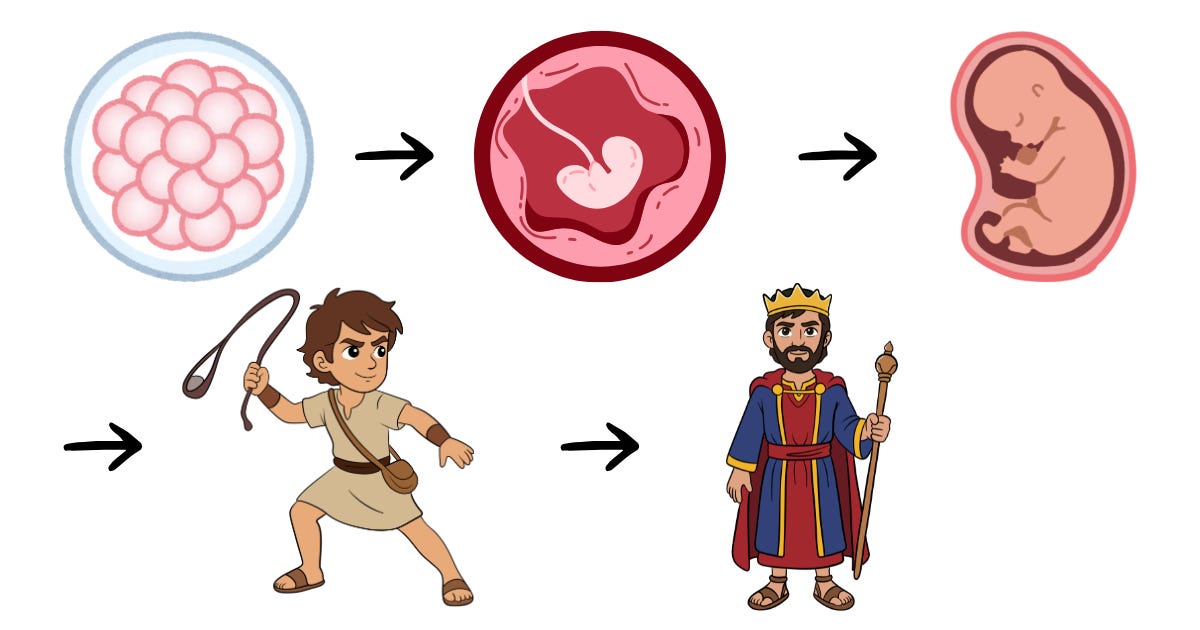
The New Testament teaches and that Jesus and John the Baptist were truly human from the moment of conception and Ancient Israel taught that embryos are children that have the same value as any other human being. But did Israel continue to teach this truth throughout the rest of the Old Testament? God answers the question for us through David in Israel’s hymnbook: the Psalms. In Psalm 51, David speaks of his sin from conception. And in Psalm 139, he describes God forming and knowing him in the womb.
What do these passages reveal about human nature, personhood, and the unborn?
David’s Godliness
David began serving the Lord at a young age. Though he was the youngest of his brothers, God told Samuel to anoint him king of Israel, “For the Lord sees not as man sees: man looks on the outward appearance, but the Lord looks on the heart” (1 Sam 16:7). However, Saul remained king, and David would wait many years before taking the throne.
David is famously known for defeating the over nine-foot Philistine giant Goliath with a slingshot and a stone while Israel’s soldiers, including King Saul, trembled in fear. While Israel was at war with the Philistines, David’s father sent him to bring food to his brothers, who were soldiers. There, David heard Goliath defy the armies of Israel and asked, “Who is this uncircumcised Philistine, that he should defy the armies of the living God” (1 Sam 17:26)? His words came back to King Saul, and he called for David. Saul told him that he could not defeat Goliath, but David said, while tending his father’s sheep, the Lord had delivered a bear and a lion into his hands, and this giant would reach the same end (1 Sam 17:31-37).
Saul permitted David to fight Goliath, saying, “the Lord be with you” (1 Sam 17:37)! When Goliath saw David coming to fight, he mocked his youth and told him that he would feed him to the birds and the beasts. But David replied, “You come to me with a sword and with a spear and with a javelin, but I come to you in the name of the Lord of hosts, the God of the armies of Israel, whom you have defied” (1 Sam 17:45). David proclaimed that the Lord would deliver Goliath into his hand, and that he would cut off his head, and feed him and the Philistines to the birds and beasts (1 Sam 17:46-47).
Goliath came towards David, and David ran at him, hitting him with one stone in the forehead. The giant fell, and David picked up his sword and cut his head off. He took his head back to Jerusalem (1 Sam 17:54). From then on Saul had David lead his soldiers and would not let him return to his father’s house, but Saul grew jealous of David’s success.
Saul sought to kill David repeatedly, forcing David to flee and hide. Yet even when David had an opportunity to kill Saul, he refused. While Saul pursued him into a cave, David cut off a piece of Saul’s robe but would not harm him, saying, “The Lord forbid that I should do this thing to my lord, the Lord’s anointed, to put out my hand against him, seeing he is the Lord’s anointed” (1 Sam 24:6).
Saul relented that day, but nevertheless, came after David again. And David entered into his camp at night while he slept, taking his spear and a jar of water. When David was at a safe distance, he called out to Saul, and he awoke and confessed his sin for seeking David’s life. David replied, “The Lord rewards every man for his righteousness and his faithfulness, for the Lord gave you into my hand today, and I would not put out my hand against the Lord’s anointed” (1 Sam 26:23).
Though Saul repeatedly tried to kill David, the Lord preserved him.
This summary of David’s life leading up to him being the king of Israel reveals that David was a very godly man who feared the Lord.
David’s Sin
After becoming king of Judah, and leading them for over 7 years, David officially became the king of all the tribes of Israel. Ever since he killed Goliath, he had spent years in battle against Israel’s enemies and in fleeing Saul. Now, he was safe from the years of turmoil with his own people.
But safety in the hand of a sinner is never a good thing. With safety, complacency often comes, if a man is not diligently pursuing God and obedience to Him. That’s what happened to David, for Samuel writes, “In the spring of the year, the time when kings go out to battle, David sent Joab, and his servants with him, and all Israel. And they ravaged the Ammonites and besieged Rabbah. But David remained at Jerusalem” (2 Sam 11:1). David was battle-weary, and he delegated his duty to God and Israel to Joab and decided to rest at home.
David took a walk on the roof of his palace and saw Bathsheba, the wife of one of his mighty men, Uriah. She was bathing. He lusted after her, inquired who she was, and sent for her. He slept with her and she became pregnant. Instead of repenting of his wickedness, he sought to cover his sin with deception and murder.
He sent word to Joab to have Uriah come to him. He returned to David, and David told him to go home and wash his feet, but when Uriah left the King’s quarters, he stayed with the servants. The following day, when David discovered what Uriah had done, he asked him why and Uriah replied, “The ark and Israel and Judah dwell in booths, and my lord Joab and the servants of my lord are camping in the open field. Shall I then go to my house, to eat and to drink and to lie with my wife? As you live, and as your soul lives, I will not do this thing” (2 Sam 11:11).
Uriah had demonstrated more love for God and his neighbor than David.
This should have shamed David, but instead, he feasted and drank with Uriah, until he got him drunk. Even in a drunken stupor, Uriah left the king’s presence and slept with the servants rather than returning to his house to sleep with his wife.
The following day, David sent a letter to Joab by the hand of Uriah, telling Joab to put him at the front line of the hottest battle, and to retreat from him, so that he would be killed. David knew Uriah was an honorable man and that he would not open the King’s letter to Joab. Thus, Uriah delivered the letter that sealed his own death. Joab did what David said, and Uriah was killed.
When Bathsheba heard of Uriah’s death, she wept and mourned. And when her time of weeping was over, David sent for her, and she became his wife.
But the Lord was displeased with him.
God sent the prophet Nathan to David to rebuke him. He told him a story of a rich man taking the only lamb of a poor man, and David was enraged and condemned the man, saying that he deserved to die, and demanded that he restore the lamb fourfold. Nathan replied, “You are the man” (2 Sam 12:7)!
Due to David killing Uriah with the sword, his baby with Bathsheba would die, and the sword would not depart from his own house. His wives would be given to his enemies, from his own household. This was later fulfilled by his own son, Absalom (2 Sam 15-18), and to a lesser degree, his son, Adonijah (1 Kings 1-2). Absalom tried to take David’s kingdom from him and he slept with his concubines on the palace roof (2 Sam 16:22).
When David’s Sin Began
When David’s son with Bathsheba became sick, he fasted and prayed, pleading for the Lord to be gracious. And when his son died, he worshipped the Lord.
David, after the prophet Nathan exposed his sin, wrote Psalm 51. It begins, “A Psalm of David, when Nathan the prophet went to him, after he had gone in to Bathsheba.” He then pleads for God’s mercy and asks Him to blot out his sin (Ps 51:1-2). But notice what he writes next,
“For I know my transgressions, and my sin is ever before me. Against you, you only, have I sinned and done what is evil in your sight, so that you may be justified in your words and blameless in your judgment. Behold, I was brought forth in iniquity, and in sin did my mother conceive me. Behold, you delight in truth in the inward being, and you teach me wisdom in the secret heart” (Ps 51:3-6).
Although David sinned against Bathsheba, Uriah, and all of Israel, he said he only sinned against God. Because God is the Creator, and since He commands us to love Him and our neighbor, He is the only One we ultimately sin against. He is the only reason we should love Him and our neighbor. Now, we do also sin against our neighbor but it’s only because God has commanded us to love them. Others are as valuable as we are.
