


Act 1
Even the purest doctrine, and church and civil order, cannot save a heart that loves sin more than Jesus.
“Without faith it is impossible to please God.”
—Hebrews 11:6
The printing press was invented in 1440. Like most of the technological advances of human history, man’s progress can be used for good or evil. The Reformation spread due to the printing press, and the common man could finally own a Bible in his own language, but pornography was distributed far and wide as well.
In the 1550’s the Reformation made its way to England, and Thomas Cranmer was tasked with turning the Church of England decidedly Protestant. Many Roman Catholics were converted due to his leadership over the churches, and the influence of the writings of Martin Luther, John Calvin, and Ulrich Zwingli. Cranmer recruited prominent Protestants John à Lasco, Martin Bucer, and Peter Martyr Vermigli to teach at Lambeth, Oxford, and Cambridge.
At the Strangers’ Church in London, Lasco served as a pastor. It was full of Protestants that had fled persecution, as well as locals that had been recently converted.
One of the families under his care was the Taylors: a husband and wife, and their four children. Their families had been tailors by trade for hundreds of years. The two oldest children were girls, then they had a boy, and the fourth was a girl as well. The boy’s name was Thomas.
When Thomas was 10 years old, he had an older friend who fled from Italy with his family to London. He was Protestant too, but he had secret sins. He shared with Thomas a book he brought from Italy, that his parents didn’t know about. It was full of lewd engravings, printed in Venice and smuggled north, images that burned in a young man’s memory. Thomas was embarrassed and convicted at first but took the book home and hid it from his family. That evening, as his father prayed for purity for the family, Thomas was cut in his heart but justified his lust with the thought: “Looking at a book couldn’t possibly hurt anyone.”
In the evening, while feeding the animals, Thomas would go look at his book in private. He began to devour it, but he did not know it was slowly devouring him. Before long, he looked at it every evening and thought about it even when he was at work. He could not wait to return home.
Thomas had always had a close relationship with his sisters. He even had occasional tea parties with the youngest, Alice. But he started to notice them in ways no brother should, even Alice. He often thought about them inappropriately. Yet, like a good Protestant child, he memorized his pastor’s catechism, which read,
Q[uestion]. 84. Can man not keep himself from sin and avoid it?
R{esponse]. If we refer to external sinful acts, such as slander, killing, adultery, stealing, drunkenness, and other things of that kind, the ability has been given us in part through the innate natural powers (we attempt it with all diligence—since surely we also have been under obligation) to keep ourselves from such sins. If we wish to consider sin as it pertains to the inner perversity of our nature, then we can never be without sin. In fact, we are unable to do anything but sin as long as we live here. (Phil. 3; Rom. 7)
Q. 85. What! Can we not satisfy the law if we outwardly preserve ourselves from sin?
R. By no means! For God has not been satisfied with the external appearance of duty, but desires the heart, because it has been corrupted with unyielding evil, by which it happens that it cannot completely observe the law, which is spiritual. (Dt. 6, 10, 11, 26; Mt. 22; Jer. 17; Rom. 7; Gal. 5)[1]
But the words rang hollow to Thomas, because he did not believe them. He believed himself and his book instead.
The Protestant influence in England was short-lived, because Mary Tudor came to power, and she led ruthlessly, gaining the moniker “Bloody Mary” due to her bloodlust and execution of Protestants. She even executed Thomas Cranmer, which was illegal, because he recanted his Protestantism; but repented publicly as he was headed to be burned at the stake. He even burned the hand that signed his recantation, first. Many Protestants fled England because of her rule.
Act 2
In 1557, after years of worshipping in darkness and living in fear, the Taylors escaped from “Bloody Mary” to Geneva, Switzerland, which was ruled by John Calvin. Geneva accepted thousands of Protestant refugees under his rule. The Taylors set up a tailor shop and began their work immediately. But Thomas brought his book with him to Geneva.
While his father worked on making suits and clothes for the locals, Thomas would get the thread and materials from his mother, and her co-workers, at a shop up the road. Several Protestant refugees’ wives and their daughters worked together there. And Thomas especially loved spending time with the girls. He would linger around them for several minutes, even after he received what he came for, because he wanted much more.
Geneva, under Calvin, was a Christian paradise. Thomas learned the gospel there, memorized the catechisms, knew the doctrines, but he never trusted them. One of the first catechism answers he learned in Geneva was Calvin’s on the Tenth Commandment:
214. M[inister]. Seeing that the whole law is spiritual, as you have so often said before, and the other commandments are not only to order outward acts, but also the affections of the heart, what more is added here?
C[hild]. The Lord wished by the other commandments to rule our affections and will, but here He imposes a law also on our thoughts which though charged with covetousness and desire, yet stop short of an active intention.
215. M. Do you mean that the least temptation that enters into the thought of a believer is sin, even though he resists it and does not consent to it?
C. It is certain that all evil thoughts proceed from the infirmity of our flesh, even though we do not consent to them. But I say that this commandment speaks of concupiscence which tickles and pierces the heart of man, without bringing him to a deliberate purpose.
216. M. You say then that the evil affections which involve a definite act of will or resolution are already condemned, but now the Lord requires of us such integrity, that no wicked desire may enter our hearts, to solicit and incite them to evil.
C. That is right.”[2]
He was looking at the book he kept hiding, every day. Not only did he not repent of his lust, but he thought about it constantly and pursued it in his heart and mind every waking moment.
One day, Alice wasn’t feeling well, so he stayed home with her. He began looking at his book, but the thought crossed his mind, as if a word from a dark man, that his sister was in the next room. So, he went to her, laid hold of her, but she screamed, managed to get free, and ran. Thomas chased, but Alice escaped into the forest.
When his parents returned home, Alice came home and told them that he looked at her like he hated her; that he grabbed her hard and was going to hurt her, but she didn’t know all that he had planned. Thomas apologized to them and Alice, and his parents did not permit him to stay with her by himself anymore.
That evening, when Thomas was supposed to be tending to the animals, but was looking at his book, a man dressed in black appeared in the back of the sheep pin. Thomas was startled at first, but then the man spoke, “Thomas, the Bible says, ‘there is no authority except from God, and those that exist have been instituted by God.’ If you’ll follow me, I’ll give you power and a disguise where you can do whatever you want to whomever you want, with no one knowing.” Thomas asked, “How can this be? What must I do?” The man replied, “You must commit your life to me, and I will make you rule over others.”
Thomas already thought of young girls as his prey. He only thought for a moment and said, “Yes. I submit.” And the man in black laid a cross down in front of Thomas and demanded, “Renounce your Christian faith by trampling this cross.” Thomas jumped up and down on the cross. Then, the man said, “Kiss my backside to show you will only serve me.” And the man turned into a black cat, turned around, and lifted his tail. Reluctantly, Thomas leaned down and kissed the cat’s backside. The fur was coarse and stank of sulfur. It then turned back into the man.
The man told Thomas that he would come to him the next evening at the same time, in the form of a black cat. He must follow him to find a wolf skin, that would change him into a werewolf when he wanted. Thomas could finally do what he longed to in his heart.
The next day, he went to work with his father, as normal. He was thinking about all he was going to do when he was a werewolf. As he picked up the materials and threads from his mother, he gazed at several of the women’s daughters, memorizing their faces, like a wolf looking at his prey.
That evening, when Thomas went to tend to the animals, sure enough, there came the cat. He took his lamp and followed him. They went through the woods and down to the creek. The cat stopped at a rock. Thomas lifted it up, and there was the wolf skin. It had a soft glow and pulsated slightly, as if it was alive. He took it home and hid it.
Act 3
The next day, Thomas told his father he wasn’t feeling well and needed to stay home. He never missed work, so his father permitted him to stay, but he was not sick. When his family left for work, Thomas waited a few hours and then retrieved the wolfskin.
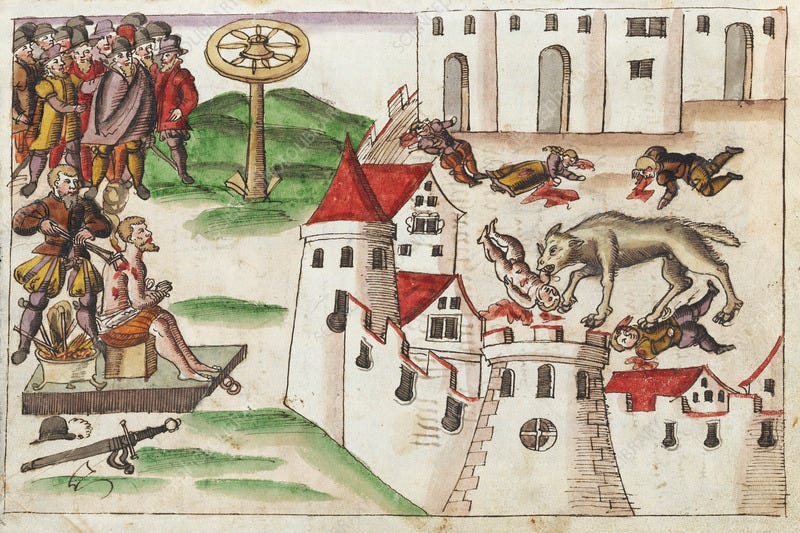
He put it on and immediately transformed into a werewolf. He walked upright like a man, but when he ran, he would drop to all fours like a wolf. His head was that of a wolf, with sharp, jagged teeth; and his nails were sharp claws. And he was hungry. Even though it was daytime, he went hunting.
